



Quick Jump to Cannabis Labeling and Packaging Rules by State:
Navigating cannabis packaging regulations is one of the most complex challenges facing cannabis businesses today. Every state with a legal cannabis program has its own set of rules governing how products must be packaged, labeled, and presented to consumers. Get it wrong, and you risk fines, product recalls, or losing your license entirely.
At RXDco, we have spent over a decade helping cannabis brands across the country design, manufacture, and deliver packaging that meets every requirement, in every market they operate in. With 100+ years of combined packaging industry experience, our team tracks regulatory changes so you do not have to.
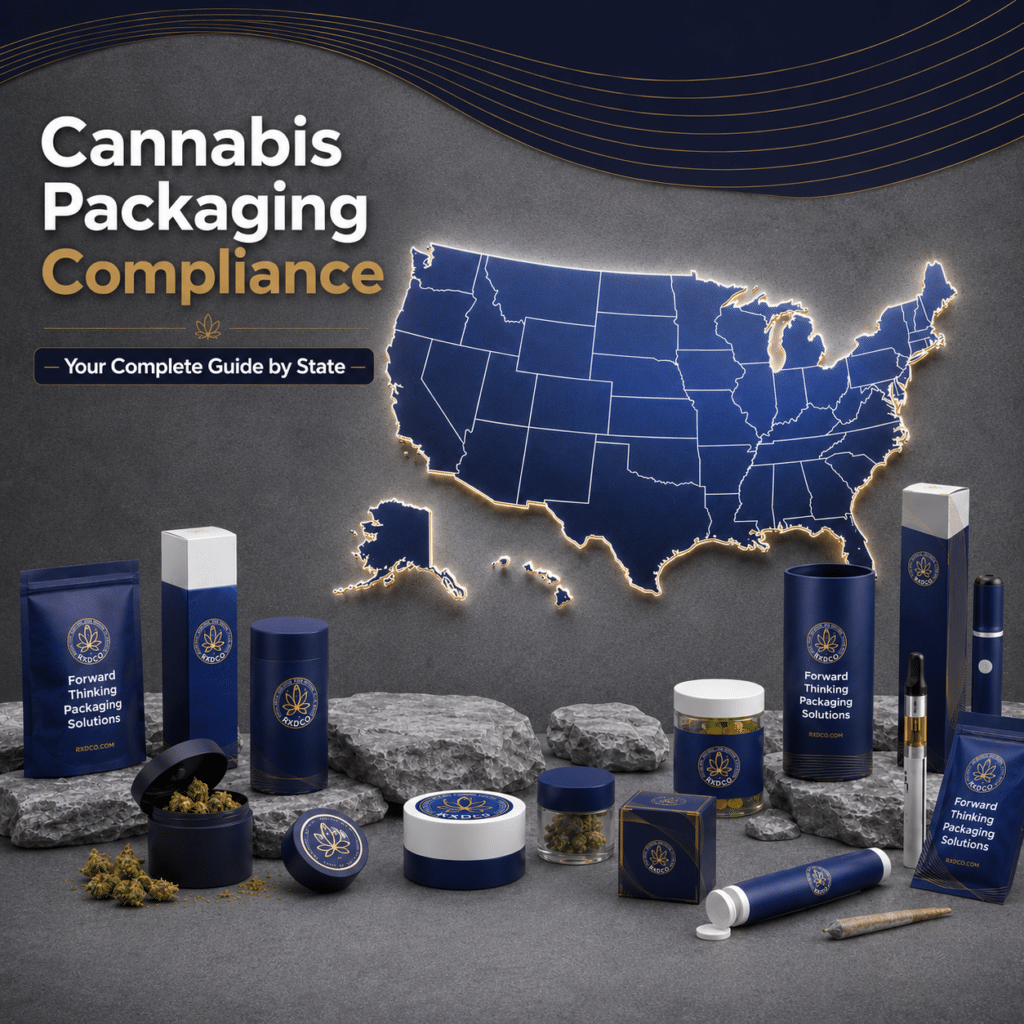
This guide breaks down the cannabis packaging and labeling requirements for each state with a legal cannabis program. Use it as a quick reference when expanding into new markets, launching new products, or auditing your current packaging for compliance.
Why Cannabis Packaging Compliance Matters
Before diving into the state by state breakdown, it is worth understanding why compliance is so critical for your business.
Cannabis packaging regulations exist to protect public safety, especially when it comes to keeping products away from children and ensuring consumers have accurate information about what they are buying. Regulators take these rules seriously. A single compliance violation can result in product seizures, hefty fines, and even suspension of your operating license.
The good news is that working with a packaging partner who understands the regulatory landscape can eliminate most compliance headaches before they start. That is exactly what RXDco’s in house design and compliance team does for brands in every legal state.
Here is what you need to know, state by state.
Alaska
Alaska’s cannabis packaging and labeling guidelines are outlined under 3 AAC 306.345.
All marijuana and marijuana products sold at a retail marijuana store must be packaged in opaque, resealable, child resistant packaging before the purchaser leaves the retail premises. The packaging must be designed or constructed to be significantly difficult for children under five years of age to open, but not normally difficult for adults to use properly.
Each package must carry a label that includes the retail store’s name or logo and license number, plus the total estimated amount of THC in the product.
Alaska also requires five mandatory warning statements on every label:
- “Marijuana has intoxicating effects and may be habit forming and addictive.”
- “Marijuana impairs concentration, coordination, and judgment. Do not operate a vehicle or machinery under its influence.”
- “There are health risks associated with consumption of marijuana.”
- “For use only by adults twenty-one and older. Keep out of the reach of children.”
- “Marijuana should not be used by women who are pregnant or breast feeding.”
RXDco compliance note: Our child resistant bags and exit bags are designed to meet Alaska’s opaque, resealable, and child resistant requirements right out of the box. Our branding and design team can build all required warning statements directly into your packaging artwork.
Arizona
Arizona’s cannabis labeling requirements fall under R9-17-317, Product Labeling and Analysis.
Dispensaries must ensure that all medical marijuana provided to qualifying patients or designated caregivers is labeled with the dispensary’s registry identification number, the amount, strain, and batch number of the product, and a mandatory warning statement from the Arizona Department of Health Services.
That required warning reads: “ARIZONA DEPARTMENT OF HEALTH SERVICES’ WARNING: Marijuana use can be addictive and can impair an individual’s ability to drive a motor vehicle or operate heavy machinery. Marijuana smoke contains carcinogens and can lead to an increased risk for cancer, tachycardia, hypertension, heart attack, and lung infection. KEEP OUT OF REACH OF CHILDREN.”
Labels must also include the date of manufacture, harvest, or sale, a list of all chemical additives (including nonorganic pesticides, herbicides, and fertilizers), and the registry identification number of the qualifying patient.
For edible products, the total weight of the edible food product must also be included on the label.
California
California has some of the most detailed cannabis packaging regulations in the country, managed by the Office of Manufactured Cannabis Safety (OMCS) under Subchapter 5 of its regulatory code.
Primary Panel Requirements
Every cannabis product label must include a primary panel displaying the identity of the product in a text size reasonably related to the most prominent printed matter on the panel, the words “cannabis-infused” immediately above the product identity in bold type and a larger text size, the state mandated cannabis product symbol (no smaller than 0.5 inch by 0.5 inch), the net weight or volume, THC and CBD content per package in milligrams, and THC and CBD content per serving in milligrams.
All primary panel text must be no less than 6 point font.
Informational Panel Requirements
The informational panel must include the licensed manufacturer’s name and contact information, date of manufacture, a full list of ingredients in descending order of predominance by weight or volume, the lot number, instructions for use, and the product expiration or “use by” date.
Medical cannabis products require additional statements including “SCHEDULE I CONTROLLED SUBSTANCE,” “KEEP OUT OF REACH OF CHILDREN AND ANIMALS” in bold print, and several other health related warnings.
For edible products, the informational panel must also include allergen warnings, artificial food colorings, and nutritional information (sodium, sugar, carbohydrates, and total fat per serving).
Labeling Restrictions
California explicitly prohibits labels that contain cartoons, any likeness to images or characters used to advertise to children, imitation of candy packaging, false or misleading information, and claims of health benefits.
Packaging Requirements
All cannabis product packaging in California must protect the product from contamination, be tamper evident, and be child resistant in accordance with the Poison Prevention Packaging Act of 1970 (16 C.F.R. Section 1700.1(b)(4)). Edible products must be in opaque packaging. Multi serving products must be in resealable packaging that maintains child resistance throughout the life of the package.
RXDco compliance note: California’s packaging requirements are among the most stringent in the nation. RXDco’s packaging solutions are engineered to meet CPSC child resistant certification standards, and our label printing and design services ensure every required element appears on your packaging. If you are entering or expanding in the California market, reach out to our team for a compliance review of your current packaging.
Colorado
Colorado’s cannabis packaging regulations are extensive, spanning multiple rule sections (M 1002 through M 1007) under the Colorado Code of Regulations.
General Labeling Requirements
All labeling text must be no smaller than 1/16 of an inch, written in English, and unobstructed and conspicuous. Multiple labels may be affixed to a container as long as no required information is completely obstructed. Health and benefit claims are prohibited.
Cultivation and Manufacturing Labels
Cultivation operations and infused product manufacturers must label every package with the cultivation license number, harvest batch number(s), net weight, a complete list of all nonorganic pesticides, fungicides, and herbicides used during cultivation, and potency information for at least THC and CBD.
Potency for flower must be expressed as a percentage range spanning the lowest to highest concentration from every test conducted on that strain within the last six months. For concentrates and infused products, potency is expressed in milligrams.
Contaminant Testing Statements
Colorado requires specific contaminant testing statements on labels. If a batch has not been tested for contaminants, the label must state: “The marijuana contained within this package has not been tested for contaminants.” If testing was performed and passed, the label must state: “The marijuana contained within this package complies with the mandatory contaminant testing required by rule M 1501.”
Retail Labeling (Medical Marijuana Centers)
When selling to patients, labels must include the cultivation license number, the dispensary license number, an identity statement and standardized graphic symbol, the harvest batch number, date of sale, patient registry number, net weight in grams to at least the tenth of a gram, and mandatory warning statements.
The Universal Symbol must appear on the front of the container, no smaller than 1/2 inch by 1/2 inch, with the statement: “Contains Marijuana. For Medical Use Only. Keep out of the reach of children.”
Potency information must be displayed either in a font size at least two sizes larger than surrounding text (not less than 10 point, bold, enclosed in a shape) or highlighted with a bright color such as yellow.
Edible Specific Requirements
Edible products require an ingredient list, a refrigeration statement for perishable items, a production date, and an expiration or “use by” date.
Child Resistant Packaging
Colorado requires all edible marijuana infused products to be packaged in child resistant containers. Multi portion edibles must be in containers that maintain child resistance for multiple openings. Non edible infused products must be individually packaged within a container prior to transport or transfer.
Connecticut
Connecticut’s packaging and labeling requirements come from Sec. 21a-408-56 of its regulations.
Producers must individually package, label, and seal marijuana products in unit sizes such that no single unit contains more than a one month supply. All products containing marijuana must be in child resistant and light resistant packaging.
Labels must include the producer’s name and address, registered brand name, a unique serial number tied to a batch and lot number (to facilitate recalls), dates of final testing and packaging, expiration date, quantity of marijuana, and a terpene profile with a list of all active ingredients including THC, THCA, CBD, CBDA, and any other active ingredient that constitutes at least 1% of the marijuana batch.
Connecticut also requires a pass or fail rating based on the laboratory’s microbiological, mycotoxins, heavy metals, and chemical residue analysis.
Delaware
Delaware’s requirements are relatively straightforward compared to other states. Compassion centers must package and label medical marijuana with the name of the strain, batch, and quantity, a statement reading “this product is for medical use only, not for resale,” details indicating the medical marijuana is free of contaminants, and the levels of active ingredients in the product.
District of Columbia
Washington D.C. requires that all dispensed medical marijuana containers bear a legible, firmly affixed label stating the cultivation center name, dispensary name, quantity, cannabinoid profile including THC level, any ingredients besides marijuana, the recommending physician’s name, the dispensing date, the qualifying patient’s name and registration card number, and a statement that the product is for medical use and not for resale or transfer.
Florida
Florida requires all cannabis products to be packaged in compliance with the U.S. Poison Prevention Packaging Act of 1970.
Labels must include a statement that the marijuana meets state requirements, the medical marijuana treatment center name, batch and harvest numbers with dispensing date, the certifying physician’s name, the patient’s name, product name and dosage form (including THC and CBD concentration), recommended dose, a warning that transfer to another person is illegal, and the state marijuana universal symbol.
Product names may not contain wording commonly associated with products marketed by or to children.
Florida also requires a patient package insert with each purchase covering clinical pharmacology, indications and use, dosage and administration, contraindications, warnings and precautions, and adverse reactions.
Edible Specific Rules
Each edible must be individually sealed in plain, opaque wrapping marked only with the marijuana universal symbol. Edible receptacles must be plain, opaque, and white, with no depictions of the product or images other than the treatment center’s department approved logo and the universal symbol. They must also include a full ingredient list, storage instructions, expiration date, and warnings to keep away from children and pets.
Hawaii
Hawaii’s packaging requirements under Chapter 32D are notable for their strict branding limitations.
All packaging must be child resistant and opaque, use only black lettering on a white background with no pictures or graphics, and be clearly labeled “For medical use only” and “Not for resale or transfer to another person.”
Additional requirements include instructions for use and a “use by” date, potency and content information, production center name with batch number and packaging date, and a tracking software generated barcode.
For capsules, lozenges, or pills, no single dose may contain more than 10 milligrams of THC. Multi dose packages may not exceed 100 milligrams of THC total.
Illinois
Illinois requires all harvested cannabis intended for distribution to be packaged in sealed, labeled medical cannabis containers. Packaging must be child resistant and light resistant, consistent with the Consumer Product Safety Commission standards referenced by the Poison Prevention Act.
Labels must include the cultivation center’s name and P.O. Box, the common name and registered product name, a unique serial number linked to batch and lot numbers, testing and packaging dates with lab identification, manufacture and “use by” dates, quantity in ounces or grams, a pass/fail rating for microbiological, mycotoxins, and pesticide/solvent analyses, and a detailed content list.
The content list must include minimum and maximum percentage content by weight for THC, THCA, CBD, and CBDA, with acceptable tolerances between 85% and 115% of the labeled amount.
Maine
Maine’s adult use labeling requirements under Section 701 are comprehensive.
Labels must include the license numbers of the cultivation facility, products manufacturing facility, and the marijuana store. They must also include an identity statement, universal symbol, and warning labels, along with the batch number, net weight, THC potency and other cannabinoid information including CBD, information on gases and solvents used in extraction, and instructions on usage.
For adult use marijuana products specifically, labels must include the amount of marijuana concentrate per serving and per package (measured in grams), a list of ingredients and possible allergens, a recommended use or expiration date, and (for edibles) a nutritional fact panel.
Packaging Requirements
Adult use marijuana must be prepackaged in child resistant and tamper evident packaging, or placed in child resistant or tamper evident exit packaging at the point of sale. Multi serving liquid products must include an integral measurement component and a child resistant cap.
Prohibitions
Labels and packaging may not violate federal trademark law, be designed to appeal to persons under 21, use false or deceptive labeling, or violate any other state labeling or packaging requirements.
Maryland
Maryland’s packaging requirements are detailed and include several important prohibitions.
Required Packaging Elements
All items must be individually packaged at the original point of processing. Packages must be plain, opaque, tamper evident, and (if applicable) child resistant. Required label elements include a finished product lot number and expiration date, warnings that only the qualifying patient may possess or consume the product, a warning to keep away from children, the Maryland Poison Control Center emergency telephone number, the licensee’s name and telephone number for reporting adverse events, allergen warnings, non cannabis ingredient listings, and an itemization of all cannabinoid and terpene ingredients by weight.
Concentrations of any cannabinoid less than one percent must be printed with a leading zero before the decimal point.
Patient Labels
When dispensed to a patient, labels must include the patient’s name, certifying physician’s name, dispensary name, dispensing date, product name, cannabinoid and terpene strength in appropriate dosage units, quantity dispensed, directions for use, and storage or handling instructions.
Packaging Prohibitions
Maryland explicitly prohibits packaging that resembles commercially available candy, snacks, baked goods, or beverages. Packaging may not contain statements or artwork that could mislead consumers about the contents, government seals or insignia, or any cartoon, color scheme, image, graphic, or feature that might make the package attractive to children.
Massachusetts
Massachusetts requires marijuana to be packaged in plain, opaque, tamper proof, and child proof containers without depictions of the product, cartoons, or images other than the dispensary’s logo. Edible marijuana infused products must not bear a reasonable resemblance to any commercially available candy.
Labels must be legible with wording no less than 1/16 inch and include the patient’s name, dispensary name and registration number with contact information, quantity, packaging date, batch and serial numbers with bar codes, cannabinoid profile including THC level, contaminant testing statement, and a mandatory FDA and safety disclaimer.
For marijuana infused products, additional requirements include the product name, ingredients list, creation and expiration dates, directions for use, allergen warnings, and the same FDA disclaimer.
Michigan
As of the publication date of the source regulations referenced here, Michigan had not yet established formal cannabis labeling and packaging requirements. Brands operating in Michigan should check with the state’s Cannabis Regulatory Agency for the most current rules, as regulations in this market continue to evolve.
Minnesota
Minnesota’s requirements under 4770.0850 are among the more detailed medical program regulations.
All medical cannabis containers must be plain, designed to maximize shelf life, tamper evident, and child resistant. Packaging may not resemble any commercially available product and must minimize appeal to children.
Trade names for medical cannabis products must clearly reflect the product’s medical nature. Names that are identical to or confusingly similar to existing non cannabis products, unlawful substances, or that suggest recreational use are prohibited.
Labels must include the patient’s registry identification number, name, and date of birth, the designated caregiver’s information (if applicable), the patient’s address, the manufacturer’s name and address, the product’s chemical composition, recommended dosage, directions for use, a full ingredient list in descending order of predominance, date of manufacture and batch number, an FDA disclaimer statement, and a notice that the product is for therapeutic use only and that diversion is unlawful.
Labels may not include any false or misleading statements regarding health or physical benefits.
Montana
As of the source regulations referenced here, Montana had not yet established formal cannabis labeling and packaging requirements. Check with state regulators for current rules.
Nevada
Nevada has particularly detailed packaging and labeling regulations under NAC 453A.
Packaging Standards
All products containing marijuana must be in child resistant packaging per 16 C.F.R. Section 1700. Solid or liquid marijuana infused products must be packaged in plastic that is 4 millimeters or more in thickness and heat sealed without an easy open tab. Liquid products may alternatively use a metal crown cork style bottle cap.
Labeling Standards
All text must be printed in at least 10 point font (not italics) on labels measuring at least 2 3/4 inches high by 4 inches wide.
Labels for products sold to dispensaries must include the establishment name and registration certificate number, lot number, harvest date, final testing date, packaging date, the full cannabinoid and terpene profile as determined by independent testing, expiration date (for perishables), and quantity.
Products may not be labeled as “organic” unless certified in accordance with the USDA National Organic Program.
Retail Labels for Usable Marijuana
Retail labels must include the cultivation facility’s name and certificate number, lot number, date and quantity dispensed (in ounces and grams), patient and caregiver information, dispensary name and address, cannabinoid and terpene profile, and two mandatory statements: “This product may have intoxicating effects and may be habit forming” and “This product may be unlawful outside of the State of Nevada.”
Accompanying material must include additional warnings about health risks, pregnancy, driving impairment, and pesticide disclosures, all printed in at least 12 point font.
Edible and Infused Product Labels
For edibles and infused products sold at retail, labels must include all of the above plus the batch number, manufacturing and expiration dates, total milligrams of active cannabinoids and terpenes, a full ingredient and allergen list, a warning about delayed intoxicating effects (2 or more hours), and extraction process disclosures.
Nevada is also one of few states that provides specific label format templates in its regulations, showing exactly how information should be arranged on the label.
RXDco compliance note: Nevada’s specific label size and font requirements make it especially important to work with a packaging partner who understands these constraints. RXDco’s label printing and design services are built for exactly this kind of precision.
New Hampshire
New Hampshire requires alternative treatment centers to provide a plan for safe and accurate packaging and labeling of cannabis, including a plan for ensuring all cannabis is free of contaminants. Specific labeling details should be confirmed with the state’s regulatory body under New Hampshire House Bill 573.
New Jersey
As RXDco’s home state, New Jersey holds particular significance for our team.
New Jersey’s cannabis labeling requirements mandate that all medical marijuana be labeled with the cultivation center’s name and address, quantity, packaging date, a sequential serial number tied to lot and bar code for recall purposes, the cannabinoid profile including THC level (not to exceed 10 percent for medical), a designation of low, medium, or high strength strain, a statement that the product is for medical use and not for resale, and a list of any ingredients besides marijuana.
All labeling must be clear, truthful, and not false or misleading. If any statements beyond those specified in the chapter appear on the label, the product must prominently display (in boldface): “This statement has not been evaluated by the Food and Drug Administration. This product is not intended to diagnose, treat, cure, or prevent any disease.”
RXDco compliance note: As a New Jersey based company, we have deep familiarity with this state’s evolving cannabis regulations. Our headquarters in Jackson, NJ puts us in a unique position to support brands entering or operating in the New Jersey market. Contact our team for a packaging consultation tailored to NJ compliance.
New Mexico
New Mexico requires manufacturers to use opaque, child resistant packaging. Labels must include the producer and manufacturer names, batch number or code, production or expiration date (with “use by” or “freeze by” dates for perishable products), a description of the number of units of usable cannabis, instructions and warnings for use, storage instructions, approved laboratory analysis results (within 10% of numbers shown on the package), strain name, product facts or nutrition panel, a statement that the product is for medical use and to be kept away from children, and the name of the approved testing facility and types of testing conducted.
New York
New York’s medical marijuana program has uniquely strict requirements that reflect the state’s conservative approach to cannabis regulation.
Approved Forms
New York limits approved medical marijuana products to liquid or oil preparations for oromucosal or sublingual administration, metered liquid or oil preparations for vaporization, capsules for oral administration, and any additional forms approved by the commissioner. Smoking is not an approved route of administration.
Packaging Requirements
All packaging must be child resistant, tamper proof and tamper evident, light resistant, and resealable to minimize oxygen exposure. The original seal may only be broken for quality testing, adverse event investigations, by the department, or by the certified patient or designated caregiver.
Label Requirements
Labels must be approved by the department prior to use. Each label must include the registered organization’s name, address, and registration number, product form and brand designation, single dose THC and CBD content in milligrams, lot unique identifier, quantity, packaging and expiration dates, storage conditions, and several mandatory statements covering medical use restrictions, child safety, driving impairment, and pregnancy warnings.
Testing and Stability
New York requires extensive lot testing by independent department approved laboratories. Each lot must be certified as passing all contaminant testing and verified for brand consistency before release. Registered organizations must also validate the stability and expiration date of each product, demonstrating a minimum of 60 days stability when opened under specified storage conditions.
RXDco compliance note: New York’s sustainability mandates for packaging align closely with RXDco’s commitment to eco conscious solutions. Our Atid collection (patented, biodegradable paper based containers) and PearlLoc line (premium paper based vape packaging) are designed to meet these evolving requirements. Explore our full range of innovative cannabis packaging built with sustainability in mind.
Oregon
Oregon’s packaging and labeling regulations under OAR 333-007-0010 are extremely comprehensive, with specific requirements for each product category: plants, seeds, usable marijuana, topicals, edibles, concentrates and extracts, tinctures, and other cannabinoid products.
Universal Requirements Across All Categories
Every product must include the producer’s or processor’s business name and license or registrant number, a package unique identification number (for licensees) or batch/lot number (for registrants), a universal symbol (at least 0.48 inches wide by 0.35 inches high), and an FDA disclaimer reading: “This product is not approved by the FDA to treat, cure, or prevent any disease.”
All labels must be in no smaller than 8 point Times New Roman, Helvetica, or Arial font, in English, and unobstructed and conspicuous.
Product Specific Requirements
Usable marijuana labels must include harvest date, strain name, net weight in both U.S. customary and metric units, THC and CBD concentrations, activation time, and lab testing information.
Edible products require the most extensive labeling, including serving size and servings per container, THC and CBD per serving and per container, a full ingredient list in descending order of predominance, major food allergen disclosures, nutritional information (sodium, sugar, carbohydrates, total fat per serving), refrigeration statements for perishables, and the warning: “BE CAUTIOUS” in bold capitals, followed by “Cannabinoid edibles can take up to 2 hours or more to take effect.”
Concentrates and extracts must include a “DO NOT EAT” warning in bold, capital letters (unless intended for human consumption), along with THC and CBD concentrations and serving size information.
Topical products also require the “DO NOT EAT” warning plus ingredient lists and suggested use amounts.
Warnings by Market Type
Oregon uses different warning language for adult use versus medical products. Adult use products must state: “For use only by adults 21 and older. Keep out of reach of children.” Medical products must state: “For use by OMMP patients only. Keep out of reach of children.” Both require a statement that it is illegal to drive under the influence of marijuana.
Label Pre Approval
Oregon requires registrants to submit labels for pre approval before transferring any marijuana item.
Packaging Exceptions for Small Containers
Products in containers too small for full labeling may use a reduced label with the principal display panel information, business name and license number, package ID, THC and CBD concentrations, and warnings. All remaining information must appear on an outer container, package, or accompanying leaflet.
Rhode Island
Rhode Island’s requirements are relatively simple. Compassion centers must package useable marijuana with a label containing the strain name, batch, and quantity, and a statement that the product is for medical use and not for resale.
Vermont
Vermont requires dispensaries to package all marijuana in an envelope or container used and intended for sale. Labels must identify the strain and weight (in grams or ounces), include a statement that the State of Vermont does not attest to the medicinal value of cannabis, note that the product is not for resale, and clearly identify that marijuana is contained within the packaging.
Dispensaries must verify the amount of all marijuana dispensed and maintain documentation with patient names, registry identification numbers, amounts, and any errors identified.
Washington
Washington’s cannabis regulations cover both packaging integrity and extensive labeling requirements.
Packaging Standards
All usable marijuana and marijuana infused products must be stored behind a counter or barrier so customers cannot directly access products. Containers must protect products from contamination and not impart any toxic substance. Marijuana infused products meant to be eaten, swallowed, or inhaled must be in child resistant packaging per the Poison Prevention Packaging Act.
Solid edible products with more than one serving must have each serving individually packaged in child proof packaging inside the outer package. Liquid edible products with more than one serving must include a measuring device (hash marks on a bottle do not qualify).
Products may not be labeled as organic unless permitted by the USDA. Producers and processors may not adulterate usable marijuana with any chemical or compound to alter the color, appearance, weight, or smell.
Label Requirements
All retail labels must include the business names and 16 digit Washington state unified business identifier numbers of the producer, processor, and retailer. They must also include the 16 digit inventory ID number from the state traceability system, net weight in ounces and grams, pesticide disclosures, and (if applicable) extraction method and solvent disclosures.
Product Category Additions
Usable marijuana labels must also include THC and CBD concentrations (total and activated forms) and harvest date.
Edible products require manufacture date, best by date, serving size and number of servings, total milligrams of active THC and CBD, a full ingredient and allergen list per the Food Allergen Labeling and Consumer Protection Act of 2004, and the warning: “Caution: When eaten or swallowed, the intoxicating effects of this drug may be delayed by two or more hours.”
Extracts for inhalation require manufacture date, best by date, and THC and CBD concentrations.
Topicals require manufacture date, best by date, and total milligrams of active THC and CBD.
Required Consumer Warnings
Washington requires a written notification with each sale covering eight specific points, including keeping products away from children, severe illness risks for children, delayed intoxication warnings for edibles (capitalized and bolded), pregnancy precautions, drug interaction warnings, impairment warnings, and that any amount of marijuana before driving may result in DUI prosecution.
How RXDco Helps You Stay Compliant in Every State
Keeping up with cannabis packaging regulations across multiple states is a full time job. Rules change frequently, new states come online, and the penalties for non compliance are real. That is where RXDco comes in.
Compliance Built Into Every Package
Every packaging solution we offer is engineered with compliance in mind. Our child resistant packaging meets or exceeds CPSC standards referenced by the Poison Prevention Packaging Act. Our tamper evident designs satisfy state requirements across all legal markets. And our packaging is tested by independent third party laboratories to ensure material purity and safety.
In House Design for Regulatory Accuracy
Our full service art department does not just make your packaging look good. They make sure every required label element, warning statement, universal symbol, potency display, and ingredient list is properly placed, properly sized, and properly formatted for your target market. If you are selling in multiple states, we build label systems that accommodate each state’s unique requirements. Learn more about our label printing and design services and branding capabilities.
Sustainable Packaging That Meets Emerging Mandates
States like New York and New Jersey are increasingly mandating sustainable packaging practices. RXDco has been ahead of this curve since we pioneered biodegradable cannabis packaging with our patented Atid collection. Our PearlLoc tubes and paper boxes give you premium, sustainable options that satisfy both regulatory requirements and consumer demand for eco conscious products.
Warehousing and Inventory Management
Compliance does not end at the label. RXDco offers warehousing and inventory management at no additional cost to packaging clients, helping you maintain organized, audit ready inventory of compliant packaging materials.
Key Compliance Themes Across All States
While every state has its own specific requirements, several themes appear consistently across all legal cannabis markets.
Child resistant packaging is required in virtually every state, typically referencing the Poison Prevention Packaging Act of 1970 and CPSC standards. If your packaging is not child resistant, it is not compliant anywhere.
Tamper evidence is another near universal requirement. Consumers and regulators need assurance that the product has not been opened or altered since it was sealed. RXDco’s shrink bands and seals and blister packs are built to meet this standard.
Opaque packaging is required in many states, especially for edible products. This prevents children from seeing the product inside and reduces the chance of the packaging being confused with conventional food items.
THC and CBD potency labeling is required everywhere, though the specific format (milligrams, percentages, ranges) varies by state.
Warning statements are required in every state, though the exact language differs. Common themes include intoxication warnings, driving impairment warnings, pregnancy warnings, and “keep out of reach of children” statements.
Batch and lot tracking is nearly universal, enabling recalls and quality control.
No appeal to minors is a consistent prohibition. This means no cartoons, no candy like packaging, no imagery that could attract children, and (in many states) no product names associated with products marketed to minors.
Stay Ahead of Compliance Changes
Cannabis packaging regulations are evolving constantly as new states legalize and existing programs mature. The information in this guide is based on state regulations current at the time of publication, but rules can and do change.
We strongly recommend working with a packaging partner who actively tracks regulatory changes and can adjust your packaging accordingly. At RXDco, monitoring compliance is part of our core service to every client.
Ready to make sure your packaging meets every requirement in every market you serve? Contact the RXDco team today for a free compliance consultation, or explore our full product catalog and services to see how we can support your brand.
Disclaimer: This guide is intended as an educational resource and general reference. Cannabis packaging regulations change frequently. Always consult your legal counsel and the relevant state regulatory agency for the most current requirements before making packaging decisions. RXDco is not a law firm and this guide does not constitute legal advice.